Discord for Larger Communities.


“Discord is both the holy grail of community management and the single most infuriating platform I’ve ever used.”

Discord Logo

Discord is a name synonymous with gaming communities, a platform that has stormed to popularity since it’s inception in 2015. Over the past five years, it’s expanded to become the primary VoIP and IRC client, allowing hundreds of millions of people not just to chat and game together, but also finding it’s place as an essential tool to keep in contact; especially during the current Coronavirus pandemic. It’s clear Discord is a useful tool in more ways than many would imagine.
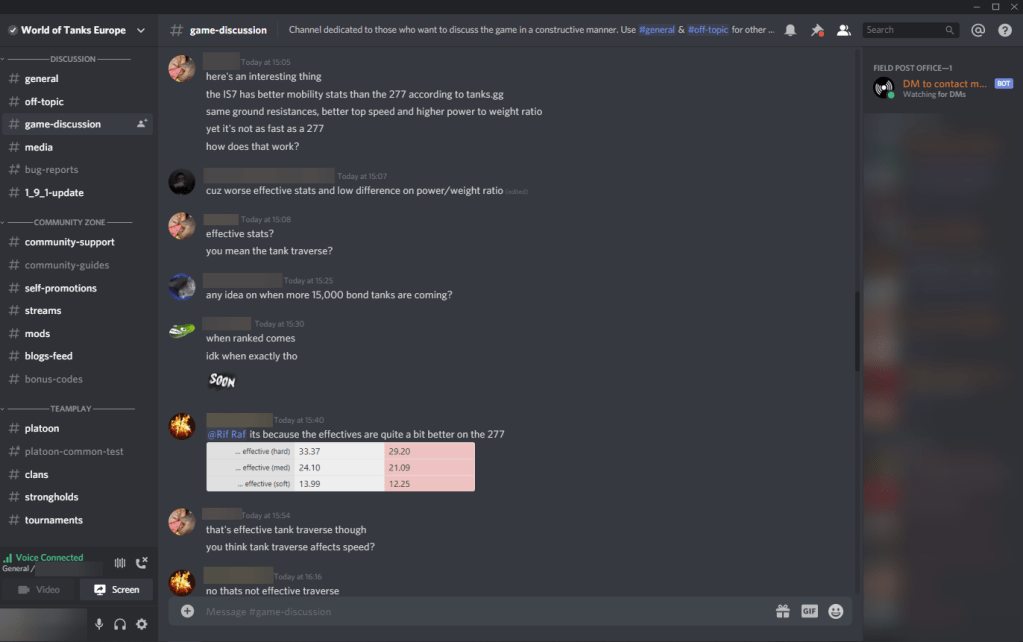

Discord is great. It’s something I use day in and day out to speak to friends, discuss the finer points of games with other members of the platform, and is also the platform my server uses as a forum for player engagement and discussion on behalf of Wargaming, the developers of World of Tanks. From the user’s perspective, it’s very difficult to not like the platform; so much so that on appearance, it’s a very strong contender for the best community platform out there, and the amount of customizability that exists in the form of the Discord API (Application Programming Interface) for bots makes the experience that much more enjoyable. It certainly takes up more of my time than I’d like to admit.


In my own experience of building Discord servers from the ground up, whether for University students or game developers, Discord is a dream to work with. The creation and building of a server is quick, snappy, responsive and gives many options for layouts and formatting, meaning it’s easy to create a unique identity and to create as thin or as fat of a server as you need to create the perfect home for your community, no matter what it surrounds. As a result of this, Discord has basically become the new ‘Messenger’ for savvy teens and adults who want a new collaborative, easily-accessible alternative that’s more fully featured instead of being built in to a larger platform and thus following the associated limitations.


However, as one of the moderators of a server that caters to 90k people and counting, Discord is both the holy grail of community management and the single most infuriating platform I’ve ever used.

Now hold on, I know a few seconds ago I was screaming “THIS IS GREAT” from the rooftops, but allow me to explain. As it turns out, Discord becomes more troublesome as a server grows, with more and more issues becoming apparent over time. For example, let me detail you four substantial issues with large Discord communities.


Issue #1: User Indexing

Indexing in this context is making a list of users currently on the server for search functions to read from; this allows us to see who is on the server at any one time. We have a LOT of people to track on this Discord, which makes it more important that this works correctly, apart from the fact that user indexing doesn’t occur past 1000 users. We are now at over 90,000.

For a moderator, this is a huge issue as it makes it difficult to find a specific person or group of people with certain characters in their name, for example. Luckily, our moderation bot (Responsible for muting, kicking or banning unruly users) helps us retain some of this functionality, however it would be better if Discord could just implement a working feature in the first place. Yes, it may be difficult to index 90k+ users, but Discord are a huge company with lots of resources that can afford to do this. So why don’t they? It’s just infuriating and arbitrary (a recurring theme with Discord).

Issue #2: Arbitrary limits

Discord lets you do a lot of awesome stuff. For instance, you can pin messages to a special list to refer back to, you can make notes on users by clicking on their name, and you can also add friends for easier messaging. These are all pretty useful features in average use, but why can you only make 500 notes, have a total of 1000 friends, blocked users and ingoing and outgoing requests, or the most annoying and arbitrary of all, have 50 pins?

When people are literally making plugins and bots to bypass these limits, there is a real issue. Discord could also afford to be much more open about the limits they impose, as you mostly find out about them as they become a problem, rather than them being properly documented.

Issue #3: The channels are alive.

So, the server I moderate has 234 channels. This is a necessity as we operate communities for multiple languages under one server; this is barely under the channel cap of 250 (!!). I realise we are pushing the limit, but why, of all the things, do our channels suddenly jump around? Arbitrary is the word of the day, and it describes this behaviour. It can happen ten times in an hour or it can happen once a week, but the fact it happens at all is an immense annoyance, and causes severe issues for us as an active community, as channels will often go to completely random places and confuse users. Many people have reported this as a bug, something to do with channel indexing, so why has it not been fixed in the months it’s existed?

Issue #i’ve lost count: The entirety of Discord Support.

With the issues we run in to, it helps to have a useful support team for when things go wrong, as they always do, no matter the quality of platform you’re using. Sadly, Discord doesn’t have this either! In almost every case, every issue we’ve had to report to Discord Support, no useful suggestions have been given, only promises to pass the issue to the development team for fixing. The fact that these issues have existed for months should give you appropriate insight on how that doesn’t happen.

The most egregious recommendation that’s made in every ticket is to ‘prune’ our member count. Pruning basically kicks inactive users from the server, and is an extremely insulting suggestion given that large servers often build their communities from the ground up over a period of years; with many bigger servers having been around since Discord’s inception. It’s also an incredibly important metric re. server performance and growth, even if pruning only kicks inactive members. Even regarding the Trust & Safety team, they are often found to be useless except in truly exceptional circumstances.

This is far from an exhaustive list of issues, but these are a selection of the biggest issues Discord has for bigger communities.


So, looking at all this, Discord. A yay or a nay? As it often does, it depends. What you have to consider as a fledging server owner is that Discord is pretty much the most popular IRC and VoIP program currently available (perhaps even the only viable one for non-business applications), which is in itself a huge pull factor. Couple that with customizability and the ease of use presented by Discord, it should immediately be a firm yes. However, going in to this, as you grow you should be ready to deal with a lot of pointless and arbitrary issues that shouldn’t exist. I’m in no doubt that another program will eventually do what Discord did to Skype and Teamspeak, the previous market leaders in group chatting and VOIP, if they do not do their absolute best to stay on top of their game, and I’m not sure that they are.

It’s inevitable that their throne will be usurped, but how soon depends on Discord being able to retain their users, which may already be a difficult sell given the current market of copycats and other applications that claim to do it better than Discord can. Only time will tell as to when this will happen, however. For now, feel free to Discord to your heart’s content; as aforementioned, it’s a strong contender for the best platform that currently exists, and luckily, the issues that come with it are solvable with a collection of bots and server templates, so as unfortunate as they are, they’re not a dealbreaker.


This has been an article surrounding Discord and it’s suitability for larger servers. If you’d like to see more articles in future, please consider dropping back in a few days or so to keep up to date.

Discord for Larger Communities.


“Discord is both the holy grail of community management and the single most infuriating platform I’ve ever used.”

Discord Logo

Discord is a name synonymous with gaming communities, a platform that has stormed to popularity since it’s inception in 2015. Over the past five years, it’s expanded to become the primary VoIP and IRC client, allowing hundreds of millions of people not just to chat and game together, but also finding it’s place as an essential tool to keep in contact; especially during the current Coronavirus pandemic. It’s clear Discord is a useful tool in more ways than many would imagine.


Discord is great. It’s something I use day in and day out to speak to friends, discuss the finer points of games with other members of the platform, and is also the platform my server uses as a forum for player engagement and discussion on behalf of Wargaming, the developers of World of Tanks. From the user’s perspective, it’s very difficult to not like the platform; so much so that on appearance, it’s a very strong contender for the best community platform out there, and the amount of customizability that exists in the form of the Discord API (Application Programming Interface) for bots makes the experience that much more enjoyable. It certainly takes up more of my time than I’d like to admit.


In my own experience of building Discord servers from the ground up, whether for University students or game developers, Discord is a dream to work with. The creation and building of a server is quick, snappy, responsive and gives many options for layouts and formatting, meaning it’s easy to create a unique identity and to create as thin or as fat of a server as you need to create the perfect home for your community, no matter what it surrounds. As a result of this, Discord has basically become the new ‘Messenger’ for savvy teens and adults who want a new collaborative, easily-accessible alternative that’s more fully featured instead of being built in to a larger platform and thus following the associated limitations.


However, as one of the moderators of a server that caters to 90k people and counting, Discord is both the holy grail of community management and the single most infuriating platform I’ve ever used.

Now hold on, I know a few seconds ago I was screaming “THIS IS GREAT” from the rooftops, but allow me to explain. As it turns out, Discord becomes more troublesome as a server grows, with more and more issues becoming apparent over time. For example, let me detail you four substantial issues with large Discord communities.


Issue #1: User Indexing

Indexing in this context is making a list of users currently on the server for search functions to read from; this allows us to see who is on the server at any one time. We have a LOT of people to track on this Discord, which makes it more important that this works correctly, apart from the fact that user indexing doesn’t occur past 1000 users. We are now at over 90,000.

For a moderator, this is a huge issue as it makes it difficult to find a specific person or group of people with certain characters in their name, for example. Luckily, our moderation bot (Responsible for muting, kicking or banning unruly users) helps us retain some of this functionality, however it would be better if Discord could just implement a working feature in the first place. Yes, it may be difficult to index 90k+ users, but Discord are a huge company with lots of resources that can afford to do this. So why don’t they? It’s just infuriating and arbitrary (a recurring theme with Discord).

Issue #2: Arbitrary limits

Discord lets you do a lot of awesome stuff. For instance, you can pin messages to a special list to refer back to, you can make notes on users by clicking on their name, and you can also add friends for easier messaging. These are all pretty useful features in average use, but why can you only make 500 notes, have a total of 1000 friends, blocked users and ingoing and outgoing requests, or the most annoying and arbitrary of all, have 50 pins?

When people are literally making plugins and bots to bypass these limits, there is a real issue. Discord could also afford to be much more open about the limits they impose, as you mostly find out about them as they become a problem, rather than them being properly documented.

Issue #3: The channels are alive.

So, the server I moderate has 234 channels. This is a necessity as we operate communities for multiple languages under one server; this is barely under the channel cap of 250 (!!). I realise we are pushing the limit, but why, of all the things, do our channels suddenly jump around? Arbitrary is the word of the day, and it describes this behaviour. It can happen ten times in an hour or it can happen once a week, but the fact it happens at all is an immense annoyance, and causes severe issues for us as an active community, as channels will often go to completely random places and confuse users. Many people have reported this as a bug, something to do with channel indexing, so why has it not been fixed in the months it’s existed?

Issue #i’ve lost count: The entirety of Discord Support.

With the issues we run in to, it helps to have a useful support team for when things go wrong, as they always do, no matter the quality of platform you’re using. Sadly, Discord doesn’t have this either! In almost every case, every issue we’ve had to report to Discord Support, no useful suggestions have been given, only promises to pass the issue to the development team for fixing. The fact that these issues have existed for months should give you appropriate insight on how that doesn’t happen.

The most egregious recommendation that’s made in every ticket is to ‘prune’ our member count. Pruning basically kicks inactive users from the server, and is an extremely insulting suggestion given that large servers often build their communities from the ground up over a period of years; with many bigger servers having been around since Discord’s inception. It’s also an incredibly important metric re. server performance and growth, even if pruning only kicks inactive members. Even regarding the Trust & Safety team, they are often found to be useless except in truly exceptional circumstances.

This is far from an exhaustive list of issues, but these are a selection of the biggest issues Discord has for bigger communities.


So, looking at all this, Discord. A yay or a nay? As it often does, it depends. What you have to consider as a fledging server owner is that Discord is pretty much the most popular IRC and VoIP program currently available (perhaps even the only viable one for non-business applications), which is in itself a huge pull factor. Couple that with customizability and the ease of use presented by Discord, it should immediately be a firm yes. However, going in to this, as you grow you should be ready to deal with a lot of pointless and arbitrary issues that shouldn’t exist. I’m in no doubt that another program will eventually do what Discord did to Skype and Teamspeak, the previous market leaders in group chatting and VOIP, if they do not do their absolute best to stay on top of their game, and I’m not sure that they are.

It’s inevitable that their throne will be usurped, but how soon depends on Discord being able to retain their users, which may already be a difficult sell given the current market of copycats and other applications that claim to do it better than Discord can. Only time will tell as to when this will happen, however. For now, feel free to Discord to your heart’s content; as aforementioned, it’s a strong contender for the best platform that currently exists, and luckily, the issues that come with it are solvable with a collection of bots and server templates, so as unfortunate as they are, they’re not a dealbreaker.


This has been an article surrounding Discord and it’s suitability for larger servers. If you’d like to see more articles in future, please consider dropping back in a few days or so to keep up to date.

Clayworking/Pyrography @ National Glass Center

After a night of little sleep, my 5:50 AM alarm goes off, for today I had a morning lecture in the National Glass Center (NGC) focused around providing inspiration and content for blogging. However, knowing what was coming today, a lack of sleep wasn’t going to kill my enthusiasm, nor was the freezing weather or the downpour I could hear hammering on the window.

The National Glass Center, Sunderland

For context: The NGC is located just west of the St. Peter’s campus of Sunderland University and is, in their own words, dedicated to “continuing the legacy of glass making, supporting and nurturing new glassmaking talent through UoS’s Glass & Ceramics degree program, and fostering enthusiasm/understanding of the material through rich & varied exhibitions and learning/participation programs”. This is a lot of language which boils down to a lot of amazing talent, both new and established, excellent and engaging exhibitions, and demonstrations from the talented teams of artists and lecturers from the university.

The lecture I mentioned earlier was slightly different to the usual; instead of the standard work-based lecture, we got an amazing opportunity to work with clay, making sculptures and objects, as well as pyrography, which for the uninitiated is using molten glass to draw, or create images/art, on paper (yes, that’s exactly as cool as it sounds: or should I say hot?).

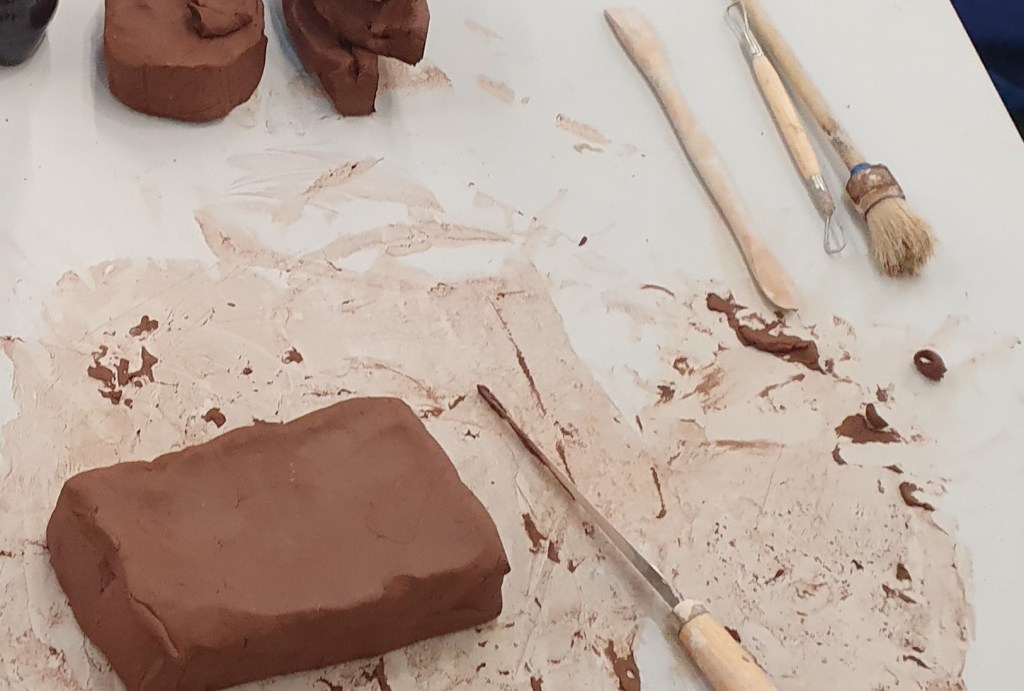
After a brief introduction from Colin, our module lecturer, and an introduction to clayworking by a student named Mary, we got to work. We all started off by using a piece of wire, similar to a garrote wire, to cut off a sizeable chunk from the large mounds of clay we were given to work with. The brief for our two week task: Create a sculpture of something that is significant to you, which will then be fired in a kiln and turned in to a ceramic piece. For this, I decided to choose a camera. Why? Cameras are how we take snapshots of the most important points in our life, the images they take often being important or sentimental to us for one reason or another. Perhaps taking a slight liberty with the task, but this wasn’t a problem.


Humble beginnings

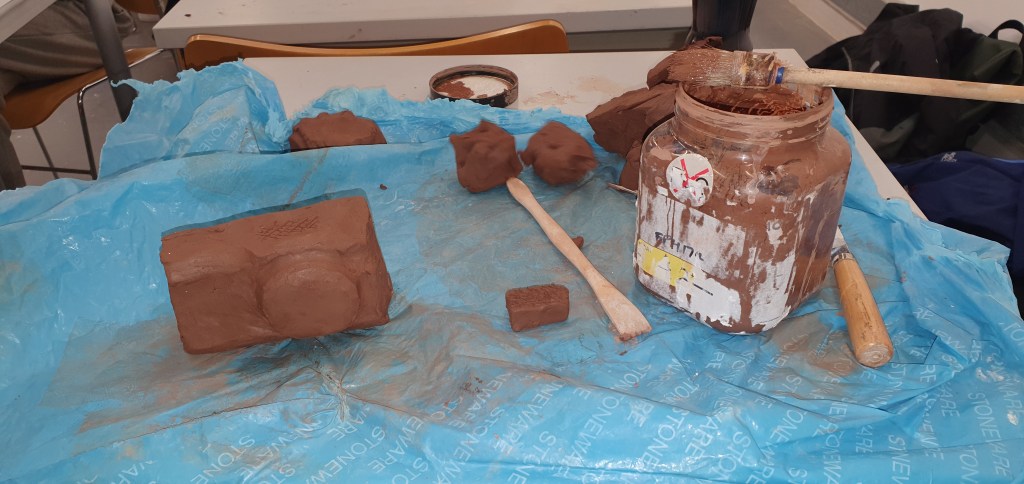
To start off with, I carved my rather blobby chunk of relatively wet clay down to a cube using a knife and some gentle tapping on the table, resulting in a relatively smooth cuboid which could then be built on, though I wasn’t as happy with the overall look of the block so far.


Next, I decided to further square off the block; I then made a rudimentary ‘lens’/lens mount to give the block some form. In my opinion, not too bad for the first time working with clay; much less making a circle, which I historically suck at! I was already pretty messy by this point, but in a way that I didn’t really mind.


Slurry time! After some further refinement, I decided to add a small flash housing on to the piece. While not required, I decided to use slurry (a wet clay) to attach it in order for it to meld better, essential for kiln firing. To use slurry you need to cut grooves in both surfaces that you want to bond, and then push them together!


The result, with a little clay around the sides to properly bond the viewfinder on to the body. This ended up bonding really solidly once I’d properly worked the clay in.


The result! Now it’s beginning to look like a camera.


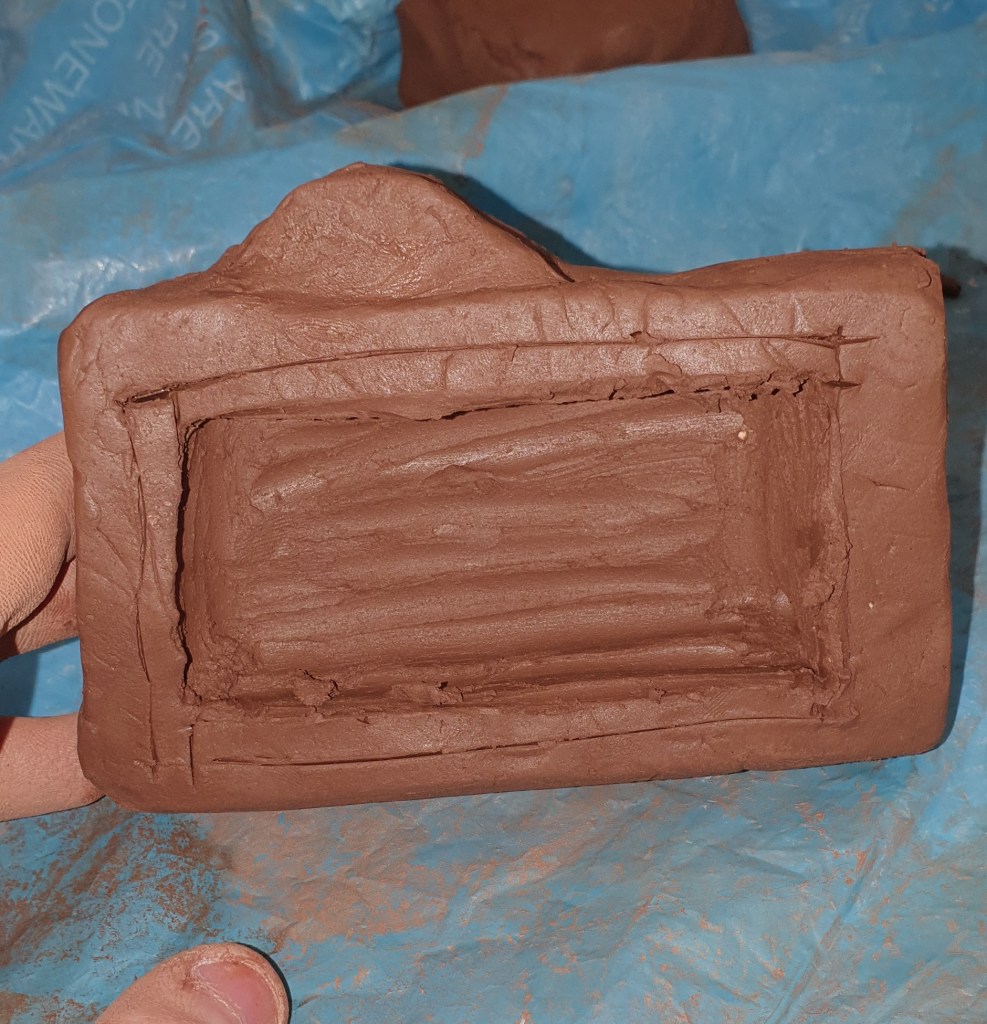
Now we need to hollow out the inside. If we don’t do this, the heat of the kiln will likely cause the piece to explode during firing, which obviously isn’t preferable! You should aim to leave ~6/8th inch of material on each side to be safe, while making sure you port the piece (poke holes to the outside), allowing air to escape.


Hollowing out the lens mount now to create a shape reminiscent of a camera mount.


Adding a control dial which would be used for adjusting various settings. This went surprisingly well as well, and attached solidly using the same technique as I did for the flash.


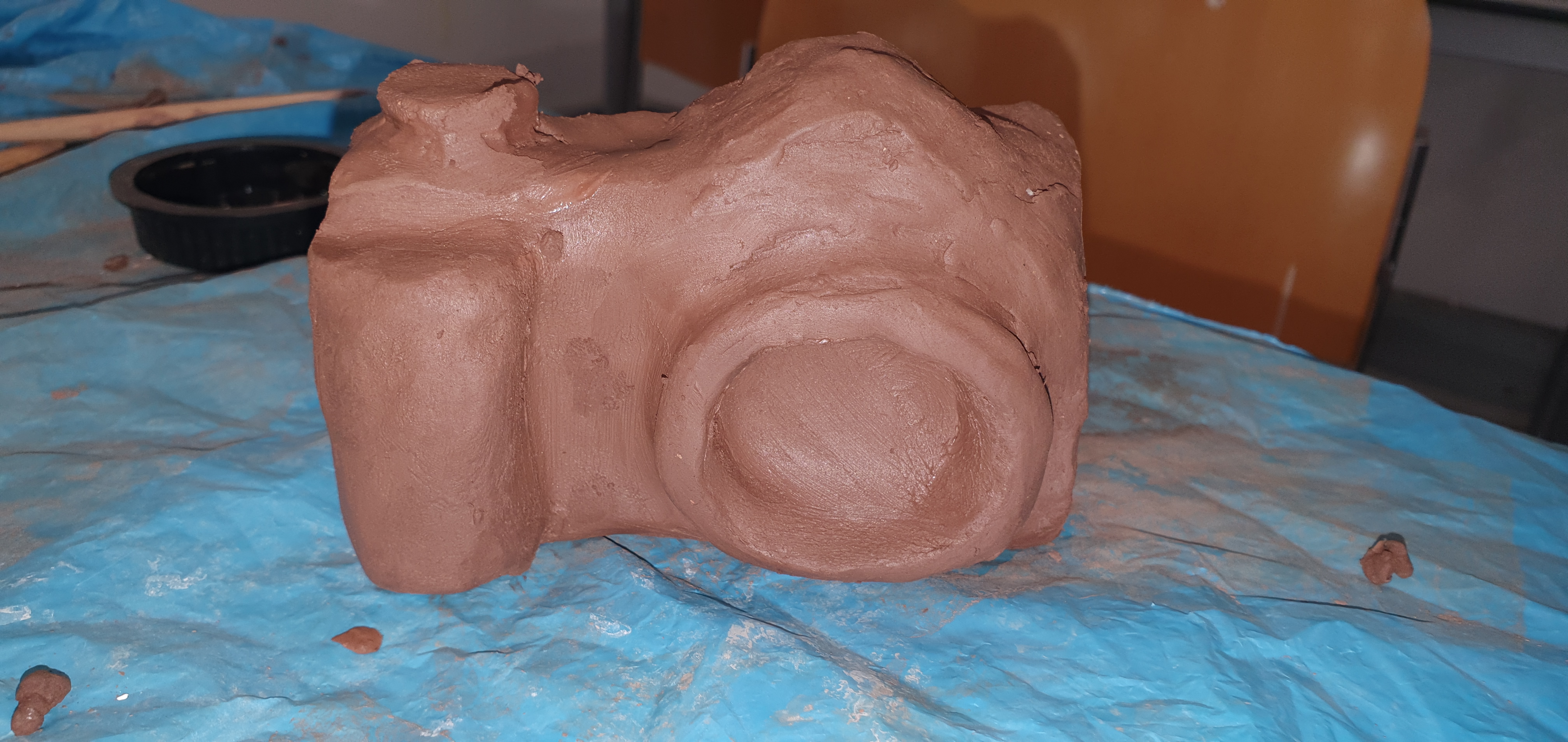
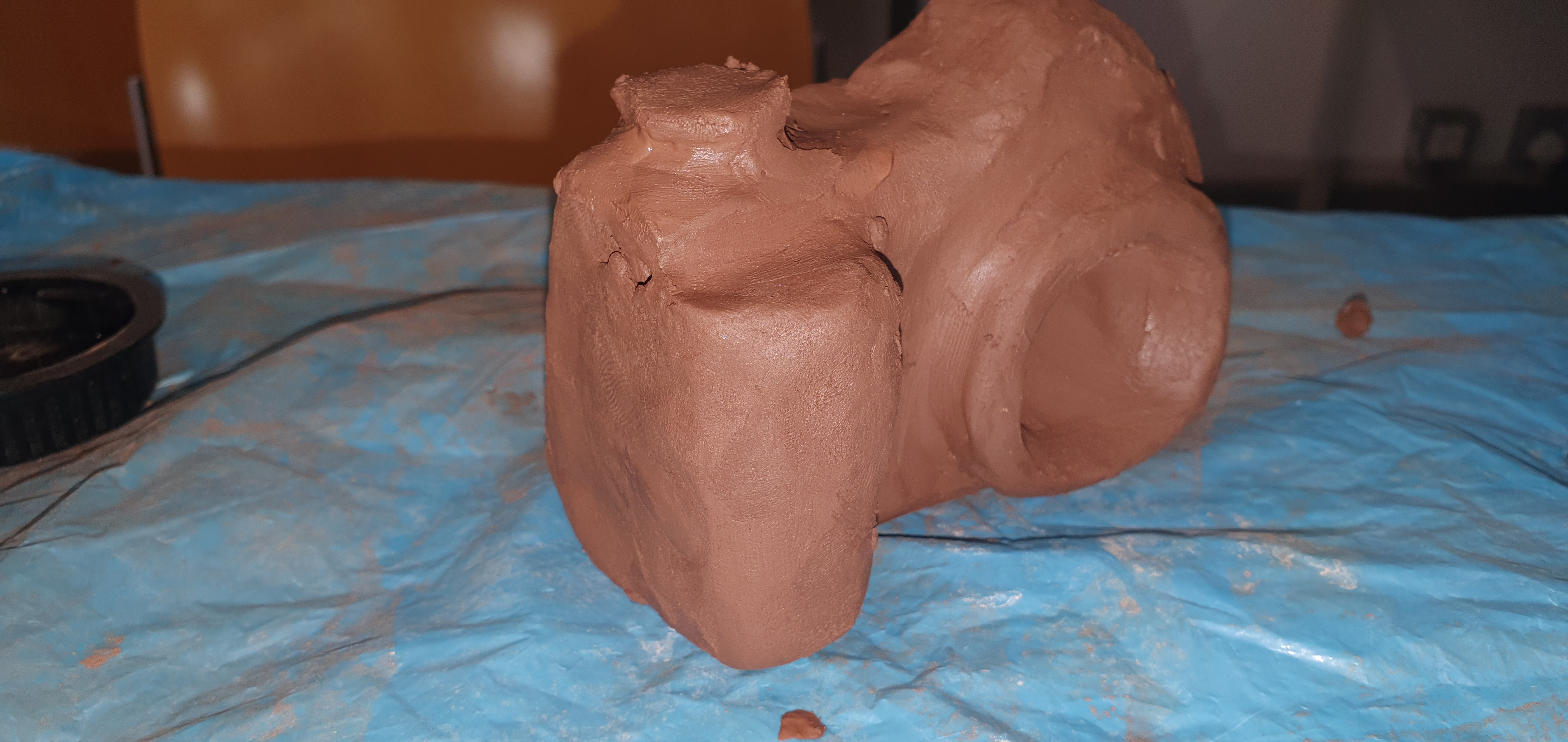
The final results! I ran out of time to make further improvements, sadly, but given the time we had to work with, I think it came out fairly well. Working with clay was fun, and definitely something I’d love to do again!


Pyrography

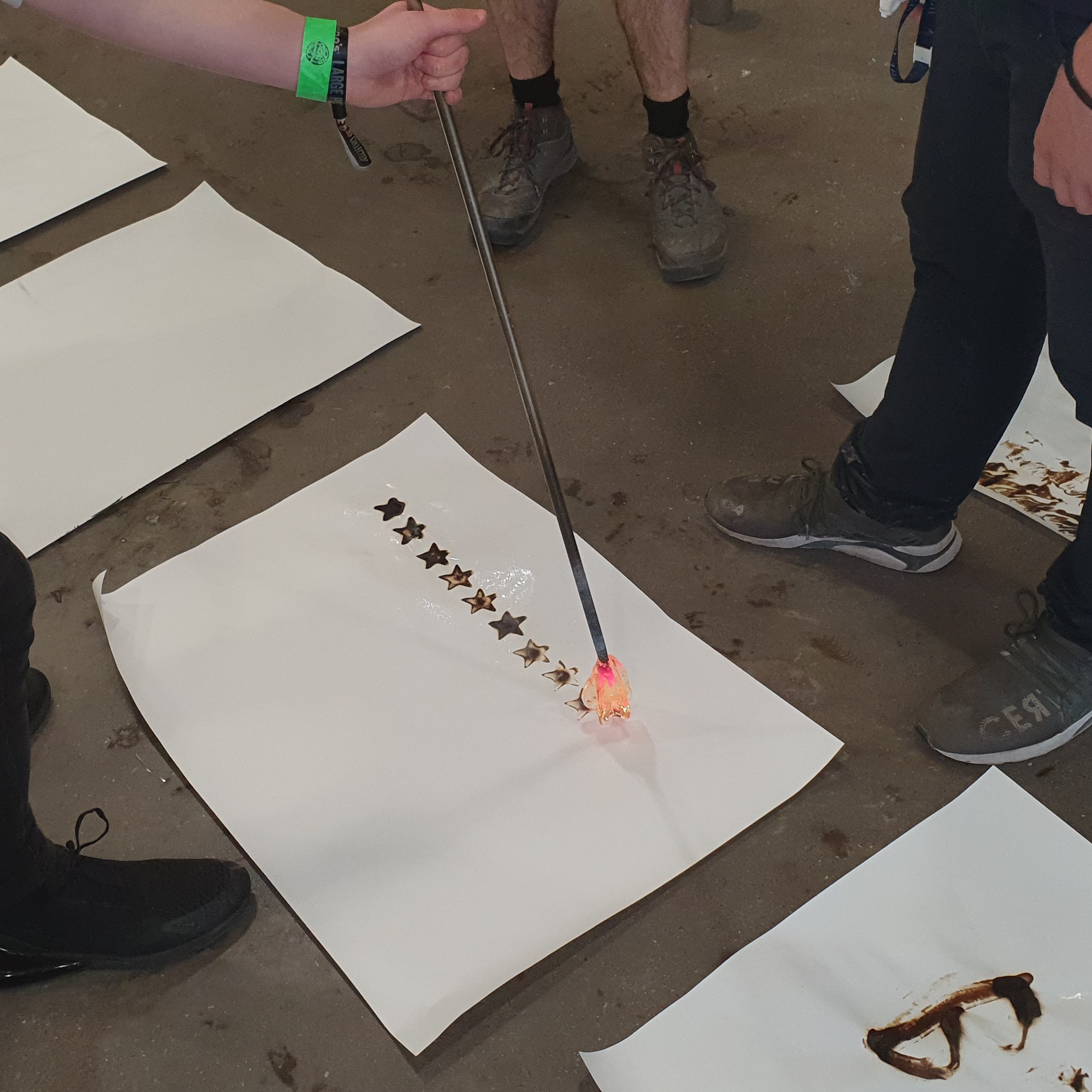
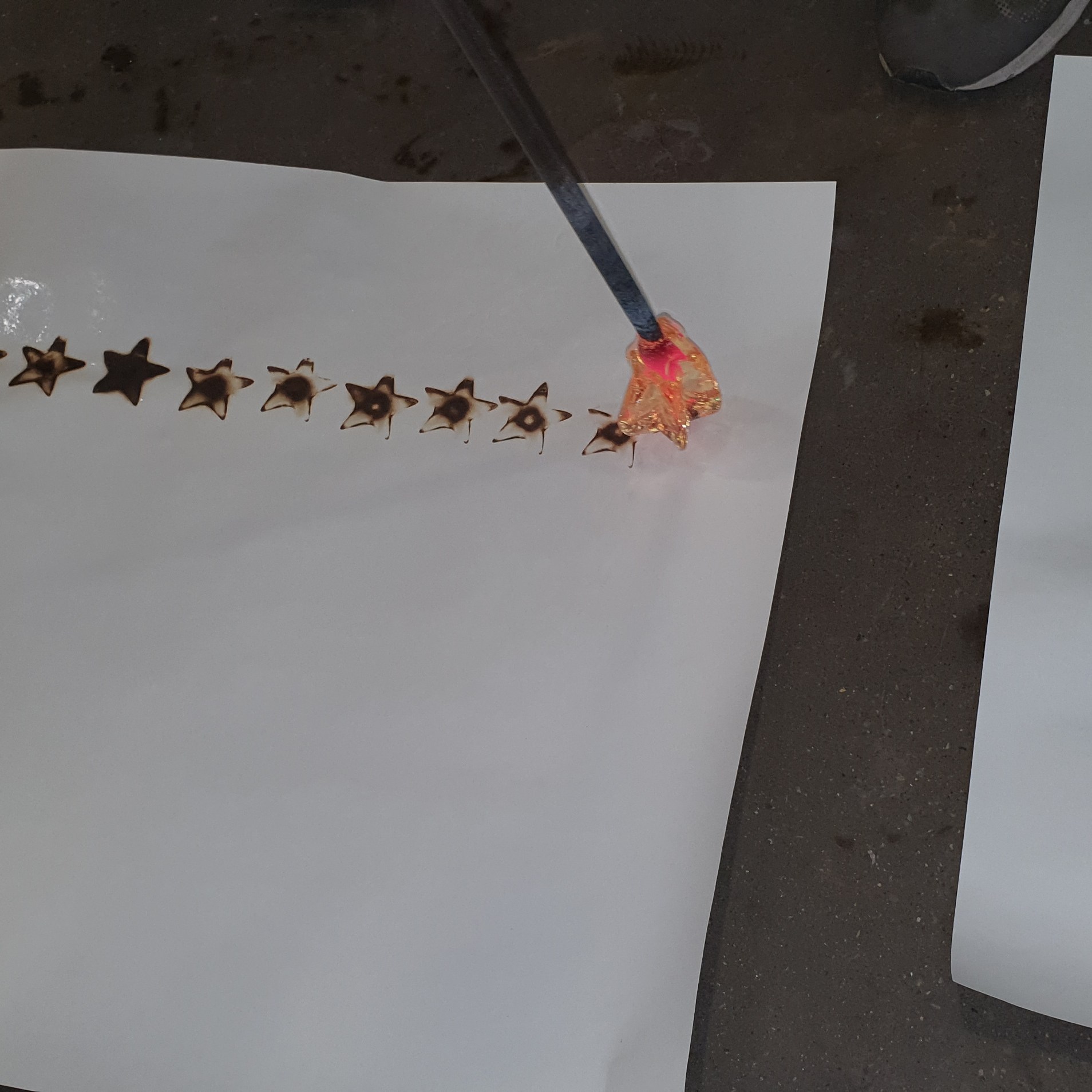
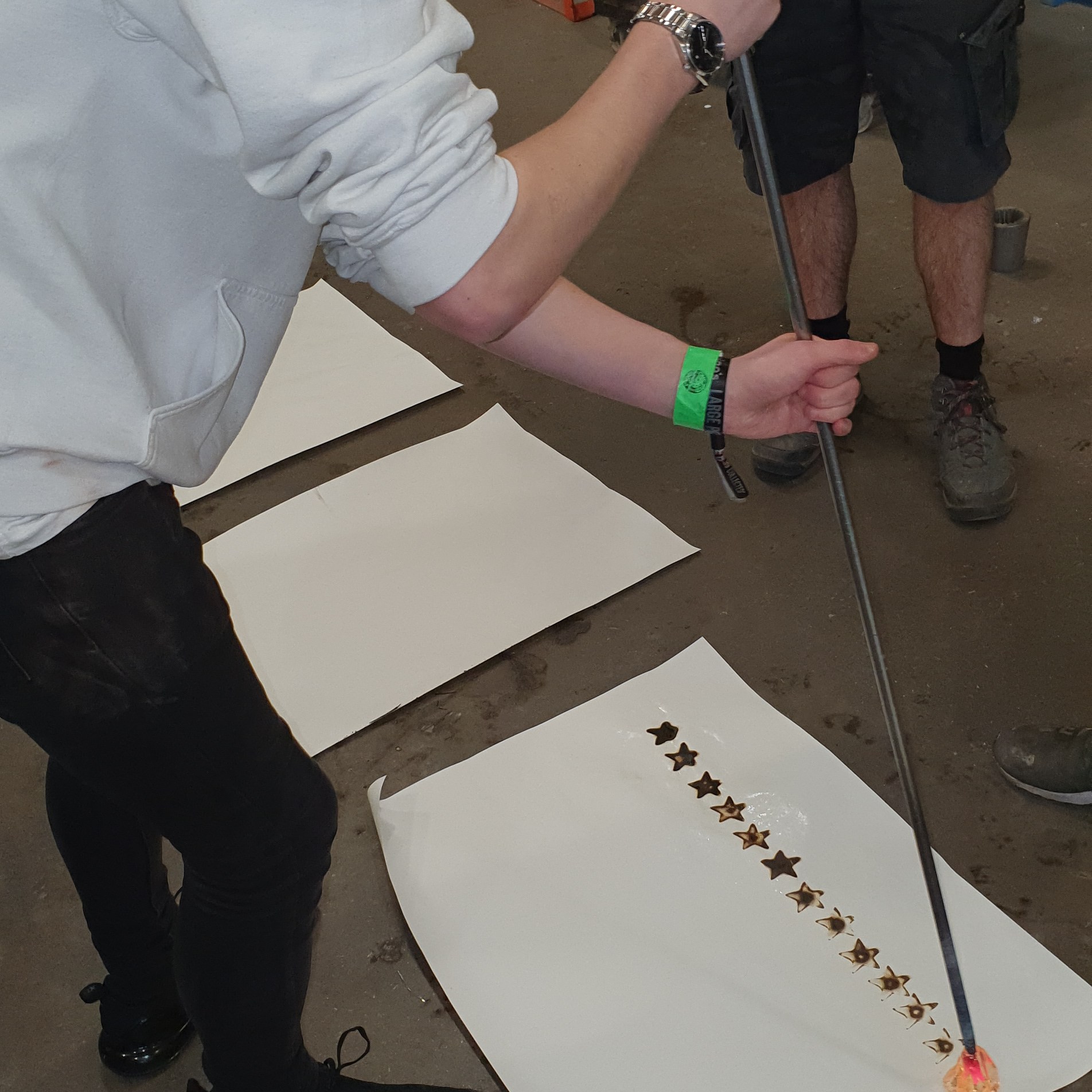
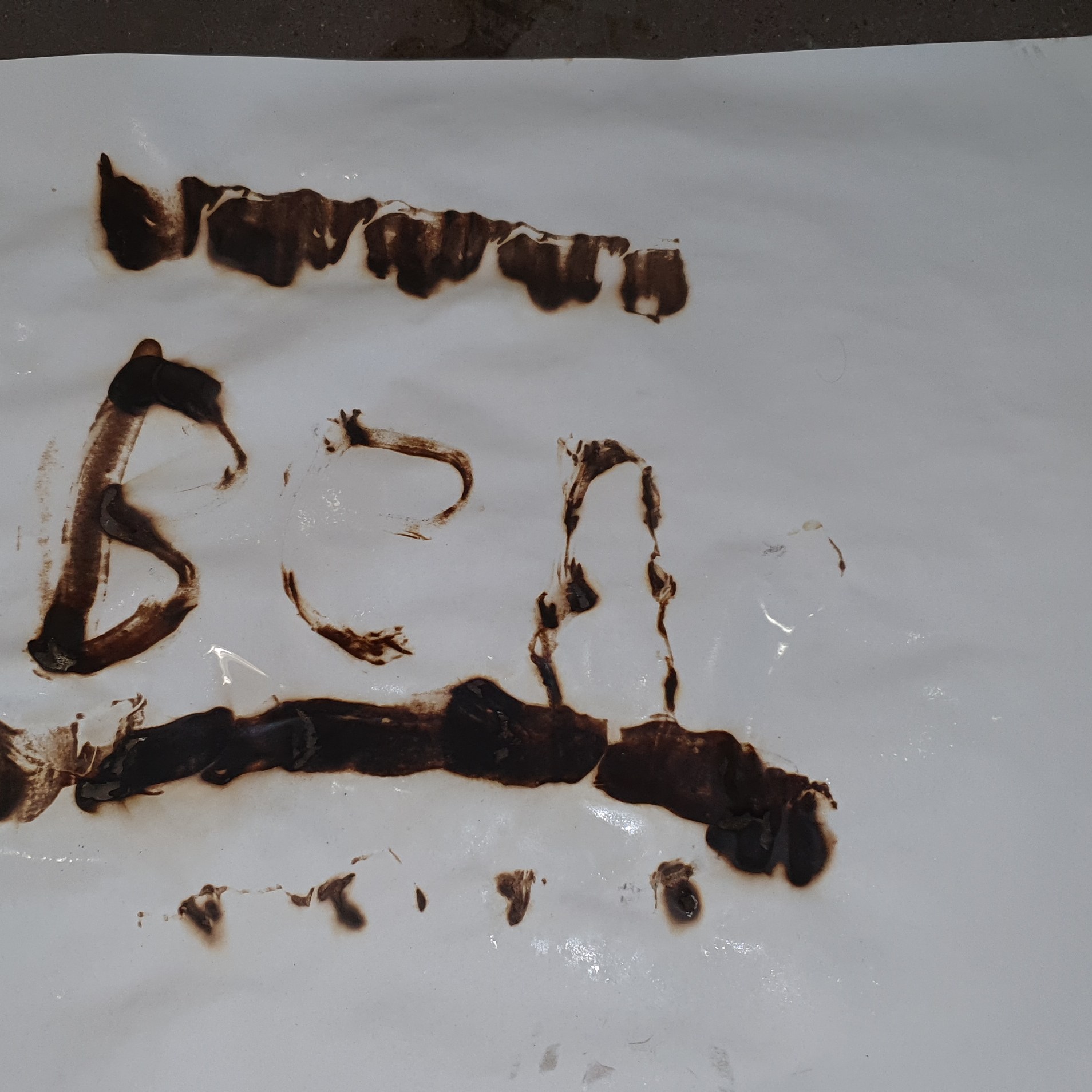
Some pictures from the pyrography session! I sadly don’t have many pictures from this one, however, I can describe the process.

Firstly, you need to lay a piece of paper on the ground and figure out what you want to do; you need to move quickly once your glass is out of the kiln, as it will drip and harden if used without a mould.

There are quite a few choices, but the ones we had open to us were the use of various star/spike moulds that would create shapes in the glass to imprint on the paper, rolling the molten glass on the paper to create our own, freeform shapes, ‘dripping’ the molten glass on to the paper or we could even try drawing with the glass like a pencil. Most of us used a mixture of these techniques, but many of us we impressed by the effect created by dripping, as well as that with the star shaped mould; it looked a lot like grass whereas dripping allowed us to make more elaborate shapes like names or even signatures, in some cases.

Jim, the technician in charge of the kiln room at that point in time, would push a metal rod deep in to the kiln and dip the end of it in glass, spinning it to create a ball of glass on the end of the rod. The rod would then be handed to us, and we had to hold it carefully in order to avoid the hot points on the rod that would cause us to burn ourselves.

It was at this point that we could use the methods described earlier to do whatever we wanted on the A3 sheet of paper. I decided to try and write my name on the paper, which I thought would be simple; the texture of the glass however is a lot more gloopy and thick than you might expect. I managed to get my name down on the first attempt, then I waited for everyone else to take their turn.

On my second go, I decided to use the star-shaped mould to try and underline my name (and as it happened, I did an overline too); a picture of the result is in the gallery below, with some other pictures showing the process!


Thanks for reading blog post surrounding Clayworking and Pyrography! If you enjoyed, please subscribe to my mailing list to be notified of further posts. Thanks for reading, and have a good day!

About Me

Greetings! My name is Benjamin, I’m 18 years old and I’m a student of Media Production at the University of Sunderland. I’m writing this blog in order to document my progress and the ideas of me and my friends as we progress through our time at the university.

I hope this will be of interest to you; I look forward to learning about blog writing and providing interesting, intellectual and overall enjoyable content to read, as well as making a memorandum of sorts for my future use.

*If you are interested, please consider signing up for the mailing list, accessible via the bottom of the home page. Thank you!

Design a site like this with WordPress.com
Get started